
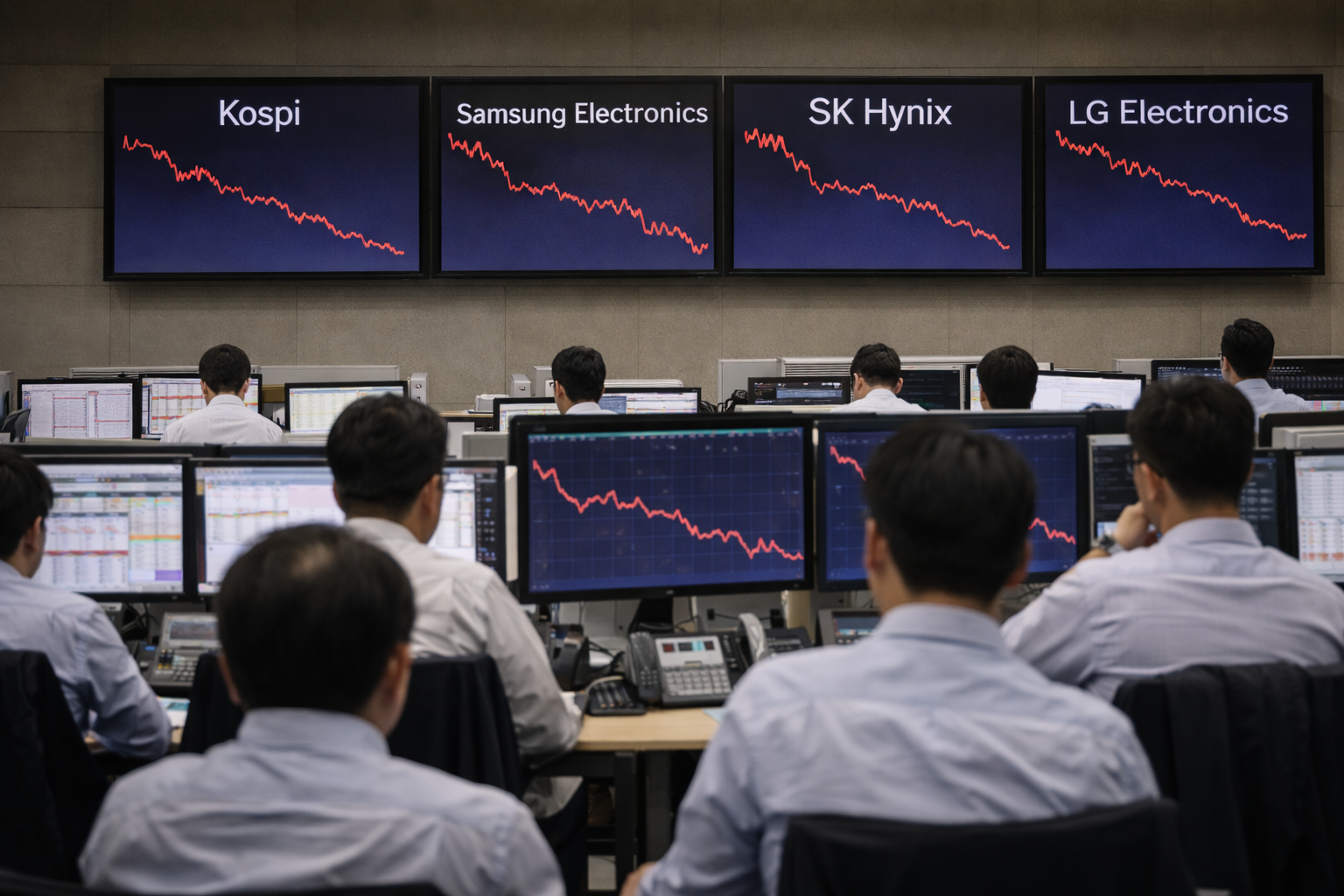
South Korea’s stock market suffered a sharp sell-off on Wednesday as investors reacted to escalating geopolitical tensions in the Middle East and rising concerns over energy prices.
The benchmark Kospi index plunged more than 12% during trading before trimming some losses later in the session.
The decline extended a steep fall from the previous day, marking one of the worst two-day stretches for the market in decades.
The Korea Exchange temporarily halted trading on the Kospi after sharp declines triggered its circuit breaker mechanism.
The technology-focused Kosdaq index was also affected, falling around 14% before stabilising.
The sudden market drop highlights the sensitivity of South Korea’s economy and financial markets to geopolitical shocks, particularly those that threaten global energy supplies.
Kospi plunge triggers circuit breakers
The Kospi index fell as much as 12.64% at its lowest point on Wednesday before recovering slightly.
Despite the rebound, the benchmark remained sharply lower and was down about 11.68% later in the session.
South Korean authorities activated a 20-minute circuit breaker after losses exceeded the 8% threshold required to temporarily halt trading.
The market decline followed a 7.24% drop in the Kospi on Tuesday, creating the steepest two-day fall in decades.
Heavyweight technology stocks led the declines.
Shares of Samsung Electronics fell more than 11.74%, while memory chip giant SK Hynix dropped more than 9.5%.
Losses also spread across major corporations including LG Electronics which plunged 14%.
According to Lorraine Tan, Asia director of equity research at Morningstar, the structure of South Korea’s stock market amplified the impact of the sell-off.
“The decline in the KOSPI can broadly be attributable to the single-name concentration that we see in the Korean markets,” Tan said in a CNBC report.
Morningstar data shows that Samsung Electronics and SK Hynix together make up almost half of the Kospi index, meaning movements in these stocks have a significant influence on the broader market.
Energy shock fears pressure markets
Rising geopolitical tensions in the Middle East have intensified fears that oil supply disruptions could push energy prices higher.
The conflict between the United States, Israel, and Iran has raised concerns about shipping through the Strait of Hormuz, a crucial maritime route that carries about one-fifth of global oil consumption.
Shipping and logistics companies were among the hardest hit sectors as the conflict disrupted traffic through the strait.
Shares of Pan Ocean, HMM and KSS Line plunged 16%.
South Korea’s heavy reliance on imported energy makes the country particularly vulnerable to oil price shocks.
The country imports about 98% of its fossil fuel needs, according to data from the US Energy Information Administration.
Nomura also flagged South Korea as one of the economies most vulnerable to current account pressures due to energy imports, noting that net oil imports account for roughly 2.7% of the country’s gross domestic product.
Sell-off follows strong market rally
The sharp correction comes after a strong rally in South Korean equities.
The Kospi surged more than 75% last year and continued to rise early this year, reaching fresh highs driven largely by semiconductor companies benefiting from strong demand for memory chips linked to artificial intelligence and data centre expansion.
Morningstar’s Tan suggested that the recent market drop partly reflects investors locking in profits after the earlier rally.
“We believe that the drop in share prices is partly driven by profit taking after a strong runup amidst a risk-off environment but also implies growing concern that the AI datacenter adoption pace might slow due to its significantly higher energy costs than regular data centers,” Tan said.
Despite the steep losses, some analysts believe the downturn may prove temporary.
Yoo said the sell-off should be viewed as a correction rather than a structural change in the market outlook.
He added that stability could return once oil prices settle and geopolitical tensions ease.
The post Kospi plunges 12% as Middle East war fears rattle South Korea stocks appeared first on Invezz
